From Finnish Air Force Hawk Training to the F-35 Cockpit
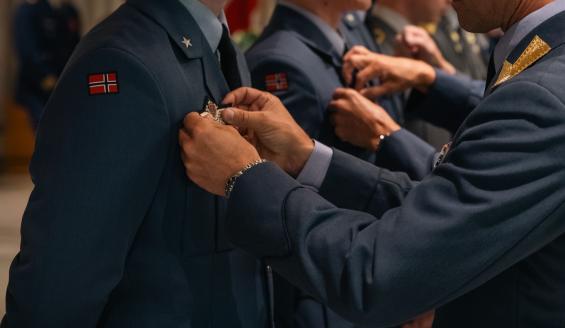
Norwegian student pilots who completed the Hawk training phase at the Air Force Academy have now graduated from F-35 training in the United States.
The Finnish Air Force and the Royal Norwegian Air Force signed an agreement on training cooperation in September 2023. At the same time, the first concrete steps in the cooperation were taken when three student pilots and one flight instructor from the Royal Norwegian Air Force arrived at the Air Force Academy in Tikkakoski, Jyväskylä.
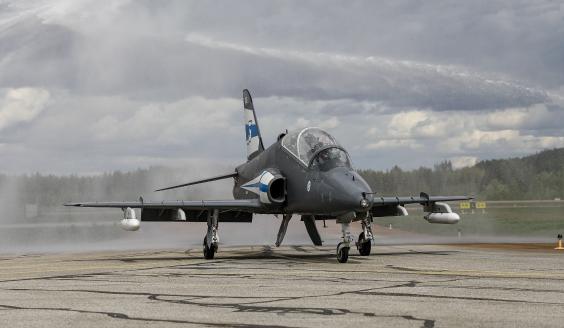
The Norwegian student pilots studied in Finland according to the Finnish flight training programme under the instruction of Finnish and Norwegian flight instructors. They progressed from the Grob G 115E primary trainer aircraft to the BAE Systems Hawk advanced jet trainer. Norway does not have its own jet trainer phase in its pilot training system. After elementary flight training, Royal Norwegian Air Force fighter pilots normally continue their training in the United States as part of the Euro-NATO Joint Jet Pilot Training Programme (ENJJPT). In Finland, the equivalent phase consists of the Hawk 1 and Hawk 2 training courses, which Finnish Air Force fighter pilot students complete in Tikkakoski as part of their fighter pilot training.
The Norwegian student pilots graduated from Hawk training in May 2025, after which they headed to the United States to continue their studies in F-35 training. In April 2026, they graduated from the F-35 training programme.
Hawk Training Prepared Pilots for the F-35 Cockpit
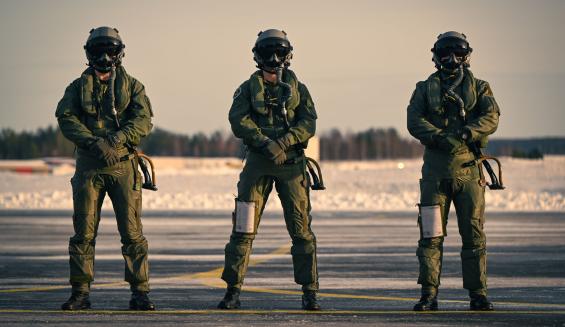
According to one of the Norwegian student pilots, transitioning to the F-35 cockpit after the Hawk training phase was a major step. The advanced systems of the F-35 fighter require extensive studying, but experience gained on the Hawk has proven highly beneficial. In particular, the latter part of the Hawk syllabus was considered extremely useful by the student pilot.
“I consider myself fortunate to have had Hawk training experience before transitioning to the F-35. Flying the Hawk has benefited me tremendously, and the transition to the F-35 cockpit went as smoothly as possible. In addition to the entire Hawk training programme, I especially value having a type of flying experience that only a few other Norwegians have. During my training, I had the opportunity to fly in several countries,” says one of the Norwegian graduates who studied at the Air Force Academy.
According to the Norwegian student pilot, the facilities and environment at the Air Force Academy enabled highly effective training. The student pilot recalls his time at the Academy warmly.
“Studying at the Air Force Academy was a great experience. The squadron spirit and culture there helped create an excellent learning environment. Experienced instructors and senior students were always willing to help younger students. The two-year training programme required a great deal of hard work, but it gave me fantastic experiences. I miss my Finnish colleagues, as well as their work culture and professionalism,” the Norwegian graduate says.
The F-35’s Stealth Capabilities Made a Strong Impression
F-35 training in the United States included classroom instruction, simulator training and, naturally, flying. According to the student pilot, there are clear differences between training in the United States and in Finland or Norway. The greatest difference is the scale of resources and personnel in the United States compared to Finland or Norway. In Finland and Norway, colleagues know each other personally, and individuals often handle multiple responsibilities. In the United States, the entire system is far larger because they train a high number of pilots every year.
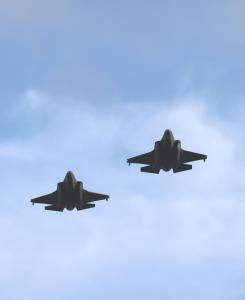
in the Baana 23 exercise. Photo: Finnish Air Force
“The F-35 is an incredible fighter to fly. The pilot receives a huge amount of information that must be prioritised correctly. It is amazing how advanced the aircraft’s capabilities
are and what we are able to accomplish with it. The fighter’s stealth technology in particular is a major difference compared to other aircraft. Another big difference is that it allows the pilot to maintain excellent situational awareness in the cockpit. On the first flight, the fighter felt extremely powerful, and the flight was somewhat stressful. Still, after extensive classroom and simulator training, it was exciting to finally experience what the fighter feels like in the air.”
Unlike after the first solo flight in the Hawk, the student pilot did not celebrate with the traditional Norwegian “Solo” soft drink.
“We still held a celebration after the successful first flight,” the graduate says.
The next step is returning to Norway.
“Now I’m heading back home to Ørland Air Base. There I will continue my training and fly as much as possible.”
More Nordic Training Cooperation
Nordic training cooperation within the Finnish Air Force has continued and expanded. The Air Force Academy welcomed additional Norwegian student pilots in September 2025, and more Norwegian students are expected to begin training during this year. In addition to Norway, cooperation has also begun with Denmark, and the first Danish students started their studies at the Air Force Academy in May 2026.


